









Benchycopter
A crossover between the classic string-launched toy helicopter and the iconic Benchy (the 3D-printing community's reference model). Designed to be fully fabricated by 3D printing — no fasteners, no glue, no post-processing — just peel it off the bed and launch.
My role
Co-author with Sebastián Varela · EUCD/FADU/UdelaR · 2021
Pair-based parametric design: joint work on propeller geometry, snap-fit shaft system and the final technical sheet.
Executive summary
A digital fabrication project. The brief asked us to design an object that took advantage of the specific affordances of FDM 3D printing, exploring print-in-place logic (parts that come off the bed already assembled or self-snap-fitting).
We combined two icons of maker culture:
- The Benchy — the reference boat used to benchmark 3D printers, recognized across the maker community. The "Benchy language" implies recognizable, easy-to-print shapes.
- The string-launched helicopter — a classic toy launched by pulling on a cord/zip tie that spins the propeller and gives it vertical thrust.
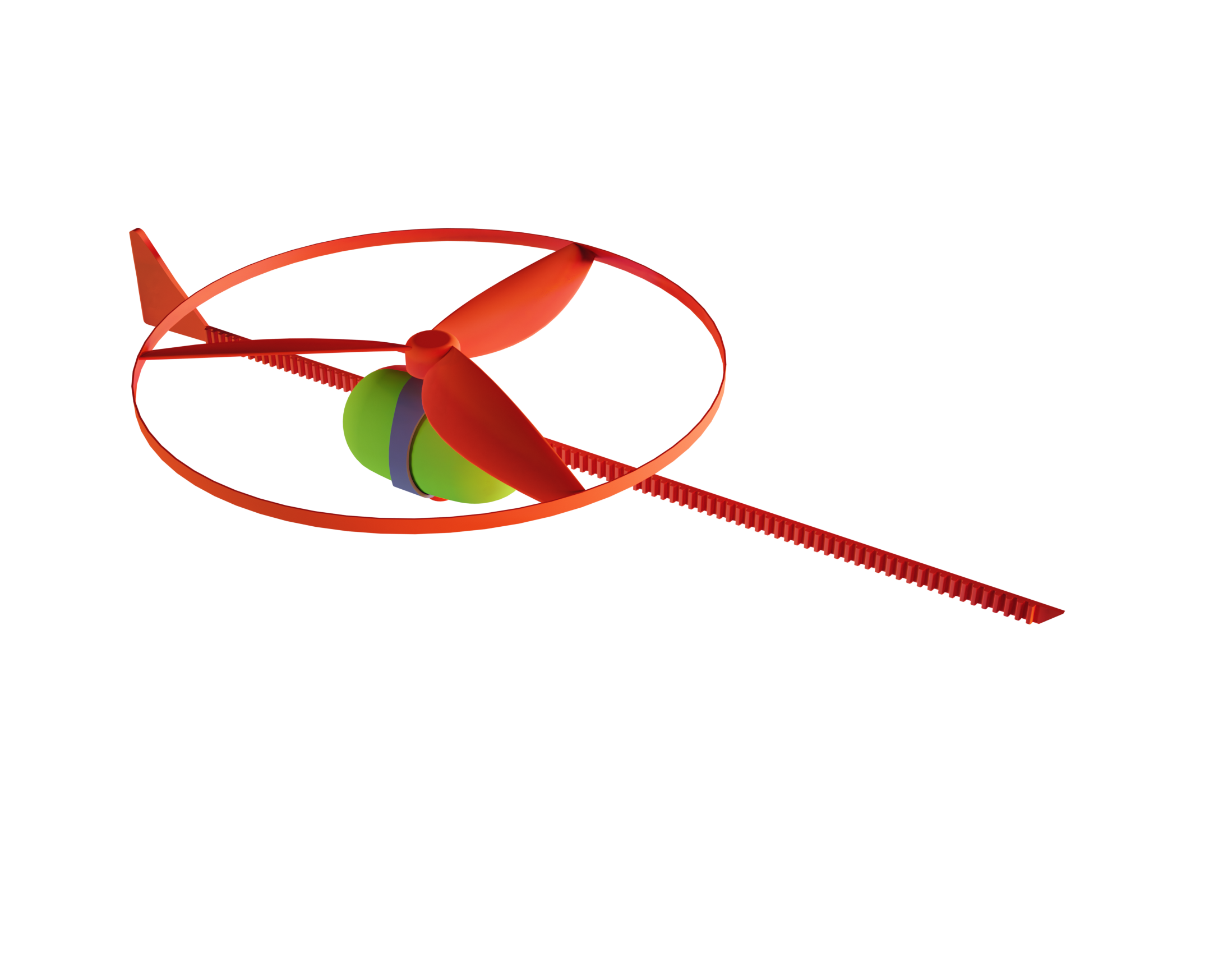
That crossover gave us the Benchycopter: a helicopter with a 3-blade propeller and a Benchy-style chassis + snap-fit shaft + a 226 mm zip-tie launcher.
The product
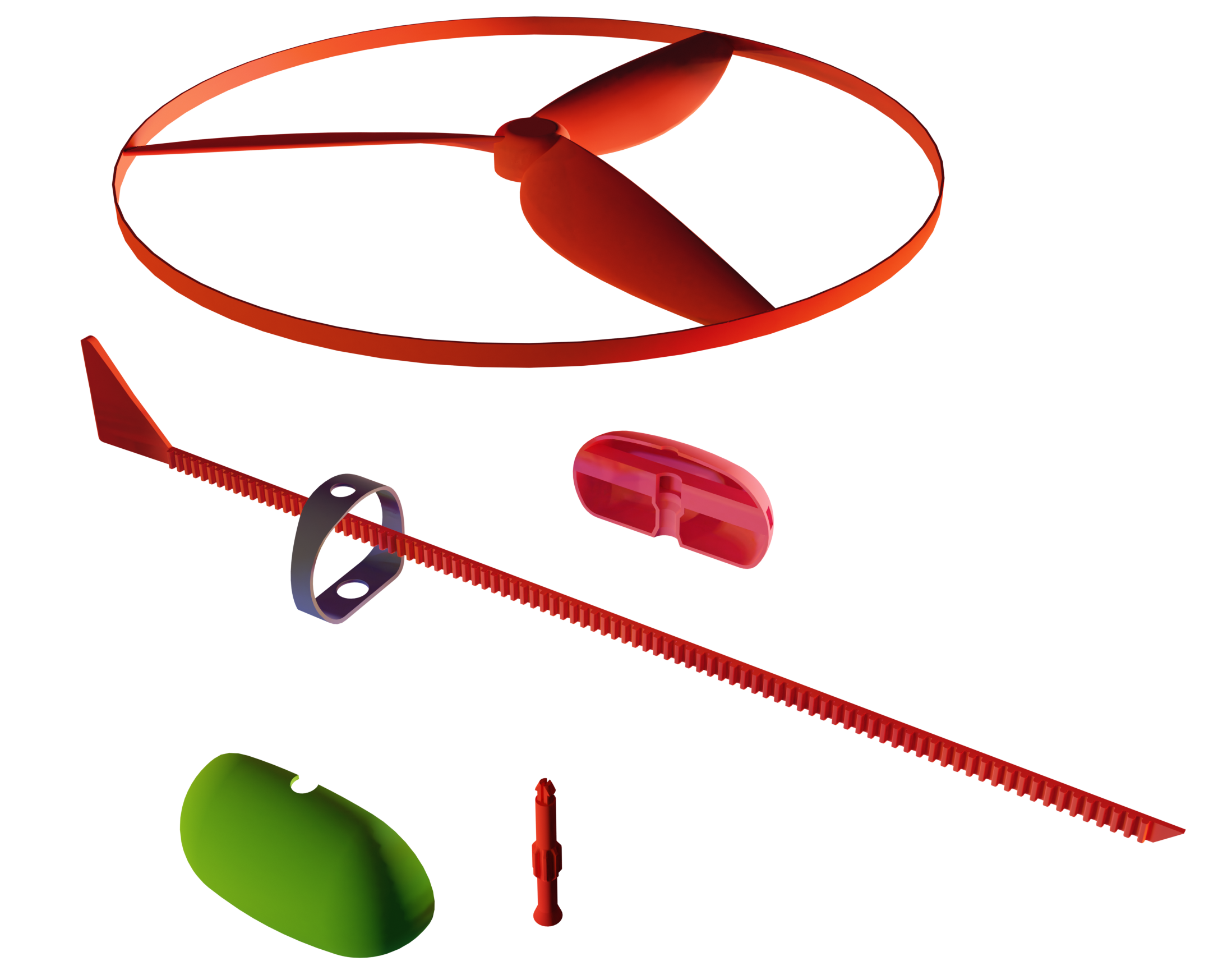
Full Benchycopter render — body, 3-blade propeller, shaft and zip-tie launcher.
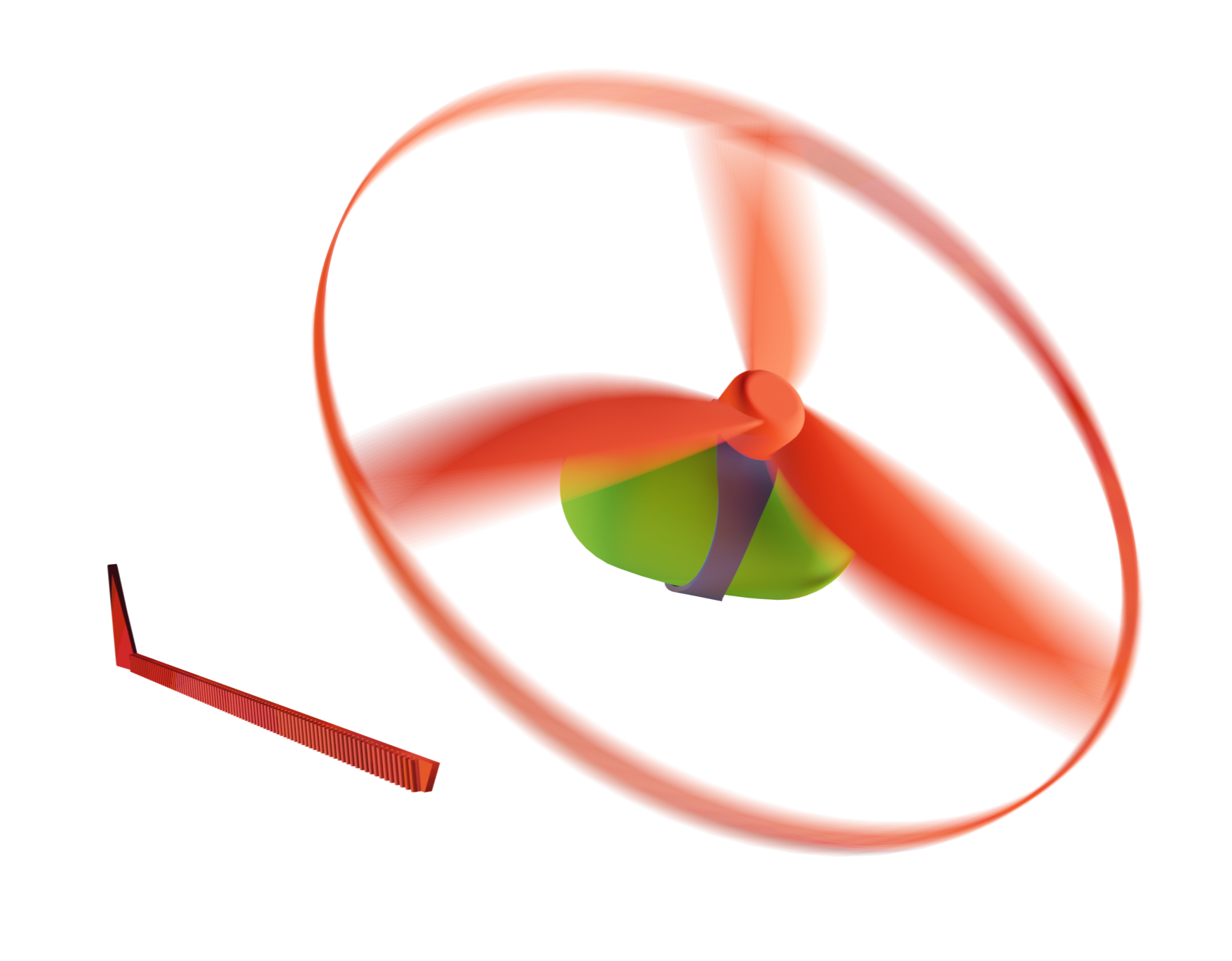
Render of the Benchycopter in flight.
Concept
A helicopter designed to be fabricated entirely in a single 3D-printing run. The bottom of the chassis acts as the launcher — pulling it spins the propeller and releases it, sending the rotor flying. The visual language is simple and friendly for any age, drawing on the Benchy aesthetic.
Components
| Part | Function | Dimensions |
|---|---|---|
| Propeller (3 blades) | Generate thrust by spinning | Ø 122.2 mm · 6.5 mm thick |
| Snap-fit shaft | Propeller ↔ chassis assembly | 37.3 mm tall · 4–5 mm diameter |
| Benchy-style chassis | Helicopter body | inside the Ø 226 mm rotor |
| Zip-tie launcher | Pull to spin the propeller and launch | 226.4 mm long |
Technical sheets
General views
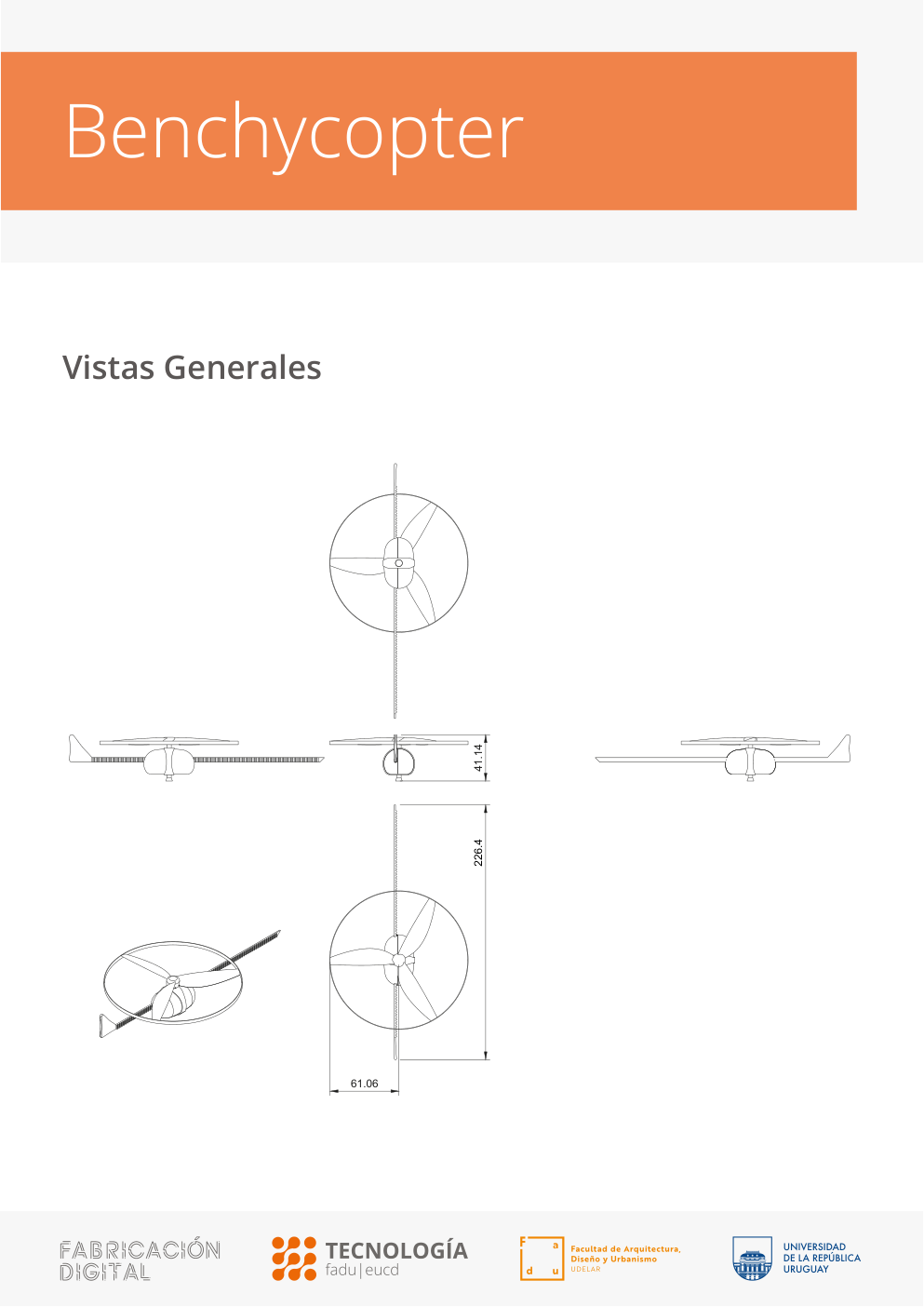
General views of the assembly (original document, in Spanish) — top, side, front, isometric. Rotor diameter 226.4 mm.
Propeller
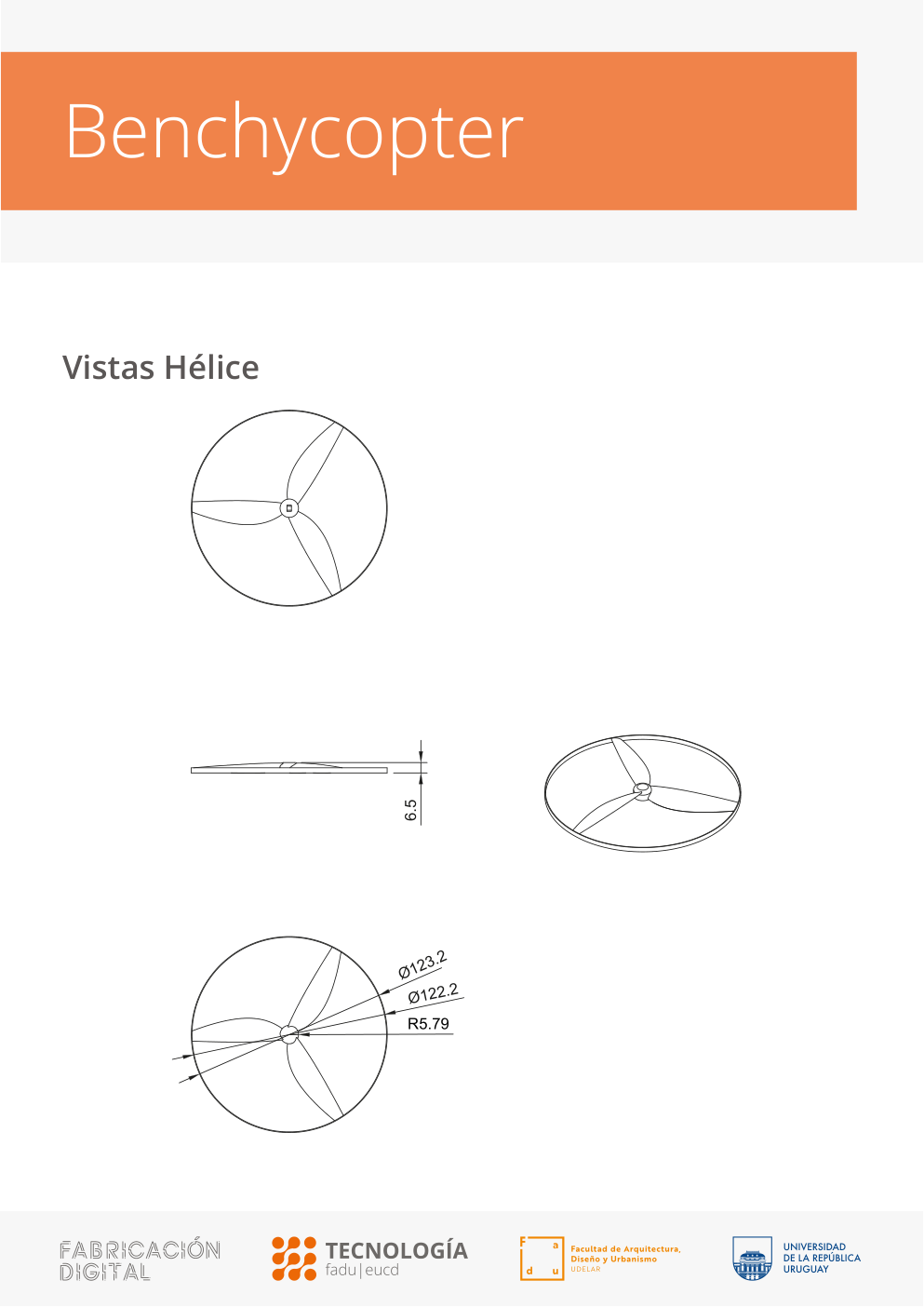
Propeller views (original document, in Spanish) — Ø 122.2 mm, 3 blades with simple aerodynamic profile, 6.5 mm thick.
Shaft
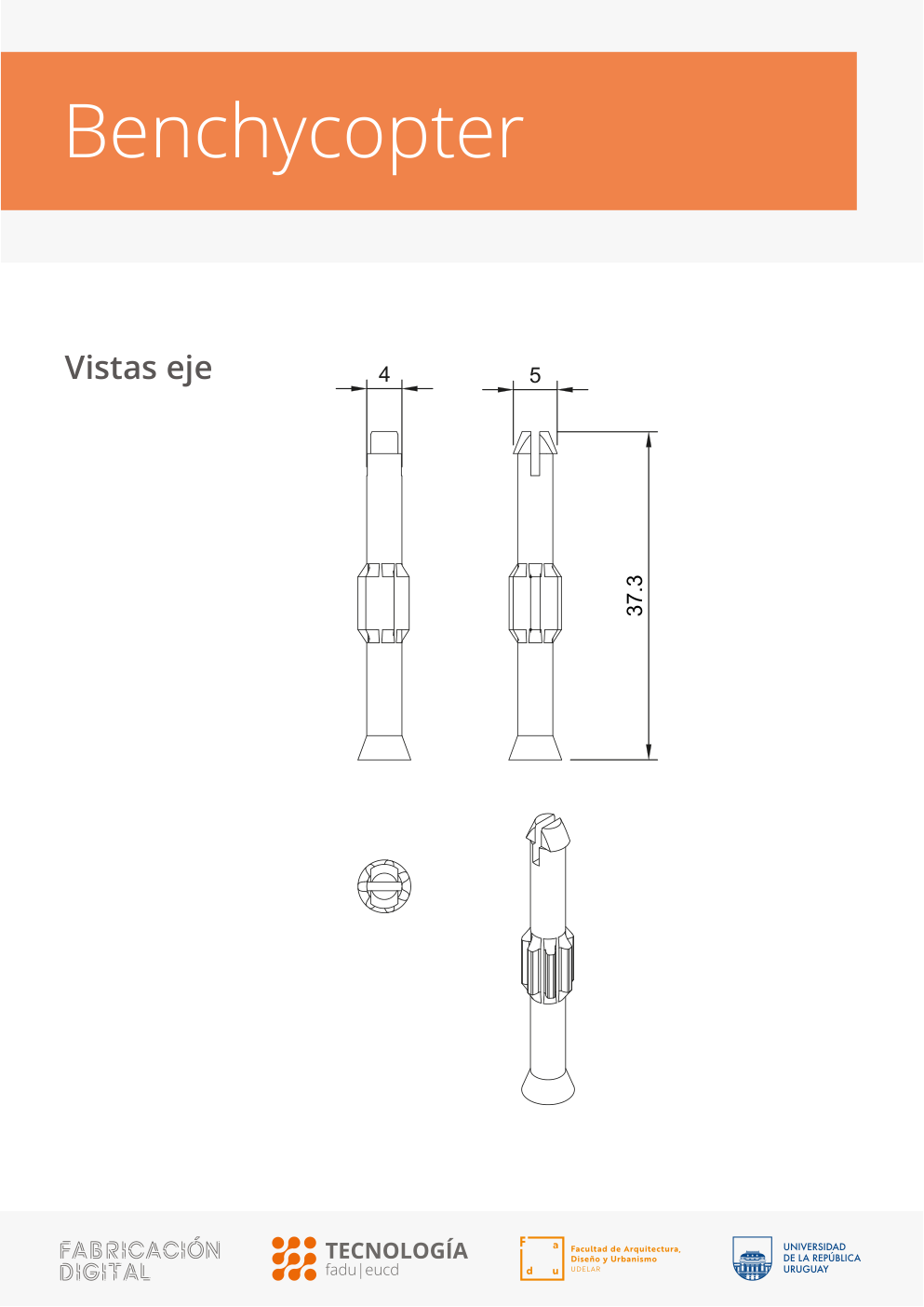
Shaft views (original document, in Spanish) — snap-fit system (4 mm at top · 5 mm at bottom) with 37.3 mm total height. Benchy-style snap-fits for tool-free assembly.
Fabrication notes
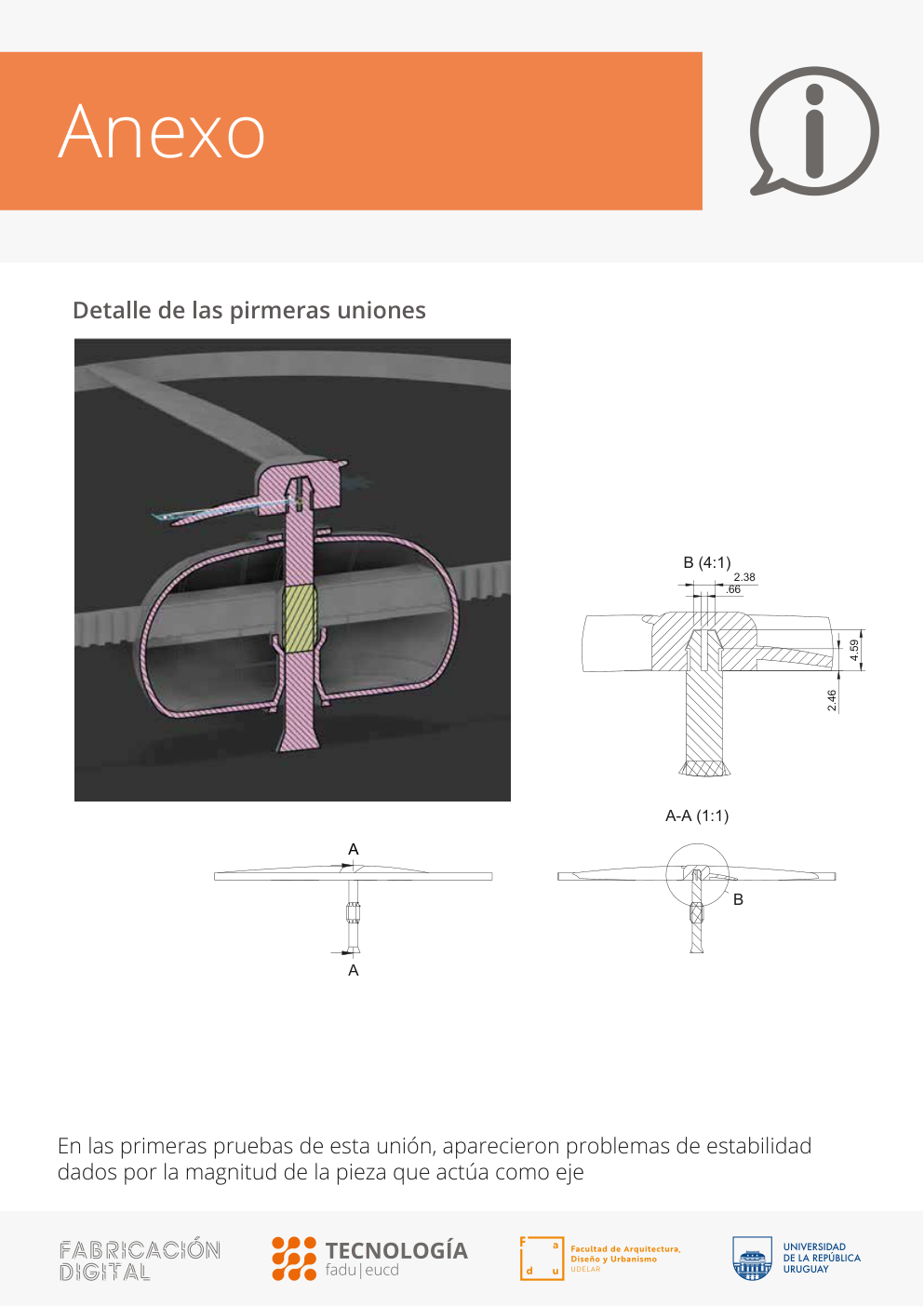
Annex (original document, in Spanish) — first-version joint detail. The first iteration of this joint had stability issues due to the size of the part acting as the rotor axis.
Iterations:
- First version of the shaft: stability issues caused by the magnitude of the part acting as the rotor axis. Redesigned with larger diameter and better mass distribution.
- Snap-fit between shaft and propeller tuned so the propeller could release from the shaft when reaching takeoff velocity (it flies freely once the launcher stops applying force).
What I learned
- Using 3D-printing logic as a project constraint — designing the object from the start as something that comes off the bed already assembled, not as something printed-and-then-bolted-together.
- Mixing cultural references — the Benchy is shared language in the maker community, and combining it with a classic toy produced an object that's understood without explanation.
- Iterating the mechanics — the first shaft didn't work. It had to be redesigned to provide rotational stability and allow release at takeoff speed.
- Pair work with Sebastián Varela — short project but with the same divergence/convergence dynamic we applied in longer projects.