
Glass Family
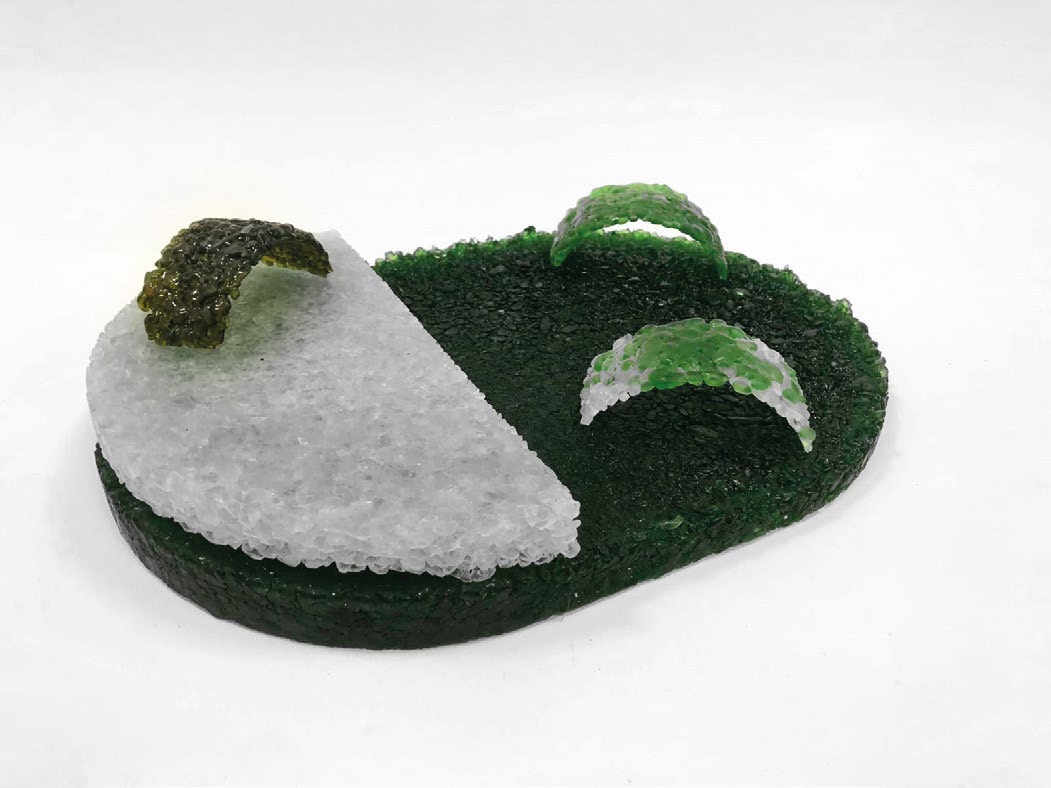
Applied research into transforming post-consumer glass bottles into a tableware family through crushing, thermal testing and kiln casting.
PAIEREAD PUBLICATIONApplied research into the transformation of post-consumer glass bottles through sorting, crushing, thermal testing and kiln casting.
Summary
This project examined discarded glass bottles as feedstock for a tableware family. The research covered bottle collection and preparation, tests with different glass compositions and particle sizes, adjustment of the firing cycle, and development of a steel mould system.
The process produced five pieces for serving sushi: one main tray, two smaller trays and two chopstick rests. Testing also identified critical production variables, including volume loss during fusion, separation between the glass and the mould, and the increased fragility of larger pieces.
Context and objectives
The research developed from earlier work undertaken in the Glass Laboratory II course at the Escuela Universitaria Centro de Diseño. Its main objective was to design a product family from single-use glass bottles using kiln casting.
The study set out to:
- identify compatibility between different types of container glass;
- assess the effects of colour, particle size, geometry and firing cycle;
- develop moulds for functional pieces;
- establish a method for collecting, processing and storing the feedstock.

Research process
The work followed four stages:
- Collection and sorting. Bottles were recovered from bars and nightlife venues over two months. They were organised by source, colour and composition, and three readily available groups were selected: fernet, clear wine and green wine bottles.
- Material preparation. The bottles were cleaned, heated to approximately 270°C and transferred to cold water to promote thermal-shock fracture. The resulting glass was sieved, washed and stored by colour and particle size.
- Testing. Samples compared compatibility, colour combinations, particle size and geometry. Evaluation recorded fusion, transparency, surface continuity, thickness and cracking.
- Firing. A cycle with stages at 680, 715 and 830°C was refined to consolidate the glass while retaining some of the texture created by the particles.


Design decisions
The application was defined around serving sushi. The family combined green glass with translucent areas, retained visible particles as part of the finish, and allowed the pieces to be used together or independently.
The mould system extended an existing laboratory mould with new steel components. Kaolin or ceramic-fibre sheet separated the glass from the metal to assist demoulding. The glass charge exceeded the intended final volume because the spaces between particles contracted during fusion.


Results and limitations
The research produced three principal outcomes:
- a five-component family developed at prototype scale;
- a documented sequence for recovery, cleaning, crushing, sorting and firing;
- production criteria for calculating the glass charge, assisting demoulding and comparing material configurations.
Using glass with a similar composition produced more uniform finishes and thicker pieces, but one large-format piece fractured during firing. The result showed that visual consistency did not ensure stability, and that scale, thickness, glass compatibility and cooling needed to be controlled together.
The study was exploratory in scope. The available documentation does not record standardised strength testing, internal-stress analysis or certification for food contact. These checks would be required before moving towards production use.


Team and documentation
PAIE 2022 project ID 85, developed at the Escuela Universitaria Centro de Diseño, FADU, Universidad de la República. Team: Lucas Irurueta, Lucía Martínez, Julieta Caja, Milena Trelles and Santiago Abásolo. Academic supervisor: Prof. Adj. Mag. Beatriz Amorín.
Suggested citation: Irurueta, L.; Martínez, L.; Caja, J.; Trelles, M.; and Abásolo, S. (2024). Diseño de una familia de productos a partir de botellas de vidrio de un solo uso [Design of a product family from single-use glass bottles]. PAIE 2022 project, Escuela Universitaria Centro de Diseño, FADU, Universidad de la República.